Ask someone how far away the next star is and you will probably hear the answer in light-years. Ask what a light-year actually measures, and the replies get vaguer. It is one of the most quoted units in astronomy and one of the most misread.
The short version: a light-year is a distance, not a length of time. It is how far light travels in a single year, moving at just under 300,000 kilometres per second. That comes to roughly 9.46 trillion kilometres, or about 5.9 trillion miles.
The figure is too large to picture, which is exactly why the unit exists. Nobody wants to write out fourteen digits every time they mention a nearby star, and nobody wants to compare a planet's distance with a galaxy's in the same breath.
What a Light-Year Measures, and What It Does Not
Light moves at 299,792 kilometres per second in a vacuum, a speed physicists usually write as c. Multiply that by the number of seconds in a year, about 31.5 million, and you have one light-year.
Most of the confusion comes from the word "year". A light-year is not a duration, and it is not a speed. It is a fixed span of space, in the same way a kilometre is. Two quick checks keep your mental model straight:
- If a star is 20 light-years away, light needs 20 years to cross that gap and reach us.
- If a journey "took light-years", it felt long. That is a figure of speech, not physics.
Every Telescope Is a Time Machine
Because light takes time to travel, looking out into space means looking back. Sunlight that warms your face left the Sun about eight minutes and twenty seconds earlier. Moonlight is roughly 1.3 seconds old. Proxima Centauri, the nearest star beyond the Sun, appears as it was about 4.24 years ago.
That is not a quirk of the unit. It is a fact about the universe, and it is the most useful thing about measuring in light-years: distance and the age of the light arrive together. You never see the cosmos as it is now, only as it was.
Andromeda, the nearest large galaxy, lies about 2.5 million light-years away. The photons reaching your eye from a dark-sky view of it set off long before our species existed.
A Short Ladder of Cosmic Distances
Keeping a few anchors in your head makes astronomy writing far easier to follow:
- Moon: about 1.3 light-seconds
- Sun: about 8.3 light-minutes
- Neptune: a little over 4 light-hours
- Proxima Centauri: 4.24 light-years
- Sirius: about 8.6 light-years
- Betelgeuse: roughly 550 light-years, though estimates vary
- Centre of the Milky Way: about 26,000 light-years
- Andromeda galaxy: about 2.5 million light-years
Notice the jumps. Inside the Solar System, light-seconds and light-hours keep the numbers manageable. Around the Sun's neighbourhood, light-years take over. Once you reach galaxies, even light-years start to look like small change.
The varying figure for Betelgeuse is worth pausing on. Distances to far-off stars carry real error bars, and different sources quote slightly different values because pinning down a stellar distance is genuinely hard work.
Parsecs, and When Astronomers Reach for Them
Light-years are not the only long ruler. Professional astronomy often prefers the parsec, which equals about 3.26 light-years. It is defined through parallax, the tiny shift in a star's apparent position as Earth swings from one side of its orbit to the other, and it slots neatly into the trigonometry astronomers already use.
Larger distances bring larger units: kiloparsecs for structures within our galaxy, megaparsecs for galaxy clusters, gigaparsecs for the very large-scale universe. As a rough guide, research papers tend to use parsecs while press releases aimed at the public use light-years. Both are correct. They are simply different rulers for different jobs.
Distance Is Only Half the Story With Stars
That bright star you noticed last night might be close and modest, or remote and ferocious. Sirius looks brilliant partly because it is one of our nearest neighbours. Betelgeuse stands out despite being hundreds of light-years away because it is enormous.
Astronomers separate the two effects using apparent magnitude, which is how bright something looks from Earth, and absolute magnitude, which is how bright it would look from a standard distance. Without a distance, you cannot convert one into the other.
A useful habit: whenever you read that a star is the brightest or the most powerful of its kind, look for a distance in the next sentence. If none appears, treat the claim with caution.
Common Misunderstandings, Cleared Up
- Treating it as a time. "It will take light-years to finish" works in conversation and fails in astronomy.
- Treating it as a speed. The speed of light is the speed of light; nobody measures it in light-years per year.
- Assuming all stars are light-years apart. Stars in a binary system can sit a fraction of a light-year apart, sometimes just light-hours.
- Assuming you see stars as they are now. You always see them as they were, whether the delay is minutes or millions of years.
A light-year answers "how far", not "how long". Once that clicks, most of astronomy's numbers start to make sense.
Putting Light-Years to Work Tonight
You do not need a telescope to use any of this. Stand outside, look up, and let the distances do the work.
- Find Sirius, the brightest star in the night sky, and remind yourself its light left about 8.6 years ago.
- Look at Betelgeuse on Orion's shoulder and hold two facts together: it is far away, and it is huge.
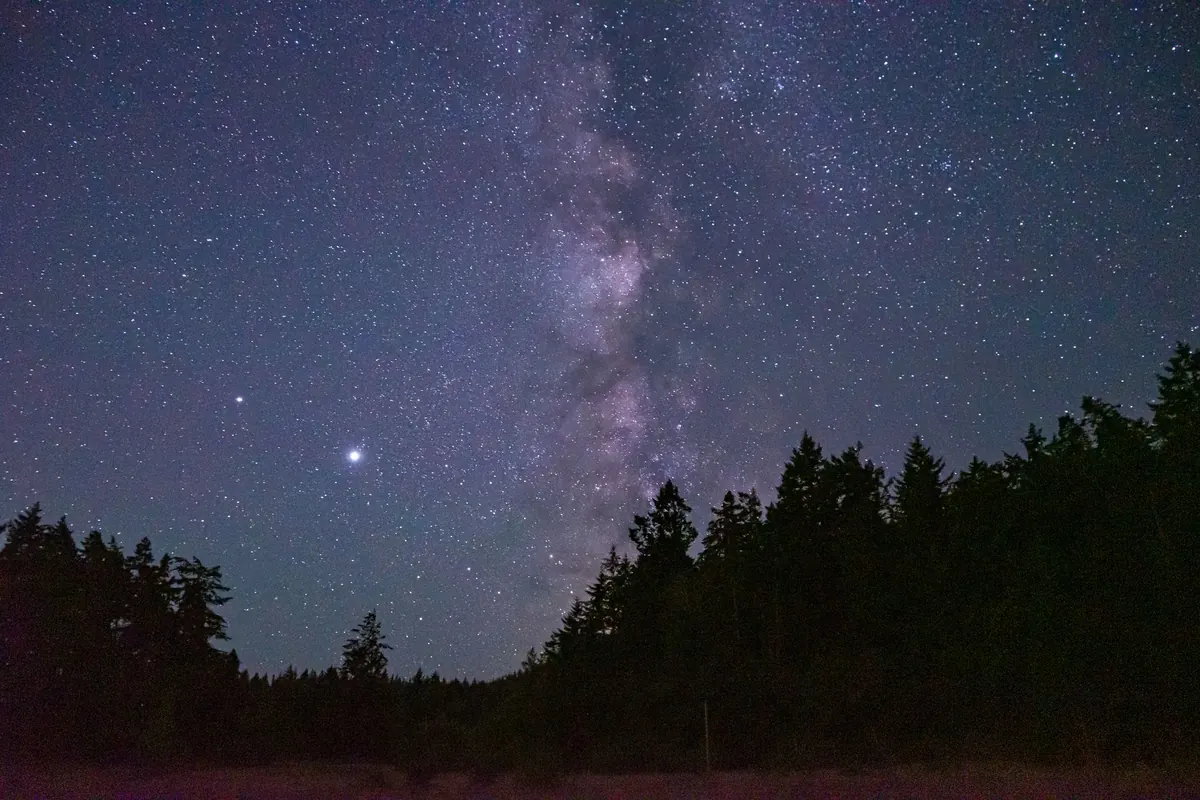
- Sweep binoculars along the band of the Milky Way. Much of that light has travelled thousands of light-years to get here.
- When you compare two stars, note distance and brightness together. Otherwise you are comparing the wrong things.
One number is worth memorising: 9.46 trillion kilometres. From there, the cosmic distance ladder — light-seconds, light-years, parsecs — stops being a wall of digits and becomes a set of tools you can actually use.
Photo: WikiImages / Pixabay